What Is a Preposition? A Complete Guide to Understanding Prepositions in English

Introduction to What Is a Preposition
Prepositions are one of the most essential parts of English grammar. What Is a Preposition Even though they are usually small words, they play a big role in how sentences make sense. Without prepositions, it would be difficult to explain relationships between people, objects, places, and ideas. These words connect different elements in a sentence and help readers or listeners understand how things relate to each other.
Many learners find prepositions confusing because they appear in many different contexts. A single preposition can have several meanings depending on how it is used in a sentence. For example, the word “in” can refer to time, location, condition, or involvement. Because of this flexibility, mastering prepositions requires practice and attention to real-life usage.
Despite the challenge, learning prepositions becomes easier when you understand their purpose and patterns. Instead of memorizing endless lists, you can focus on how prepositions function within sentences. When you recognize the relationships they express, their meaning becomes clearer.
In this article, we will explore What Is a Preposition, how it works in English grammar, the types of prepositions, common examples, rules of usage, and practical tips for mastering them. By the end, you will have a clear understanding of prepositions and how to use them confidently in writing and speech.
Understanding the Definition of a Preposition
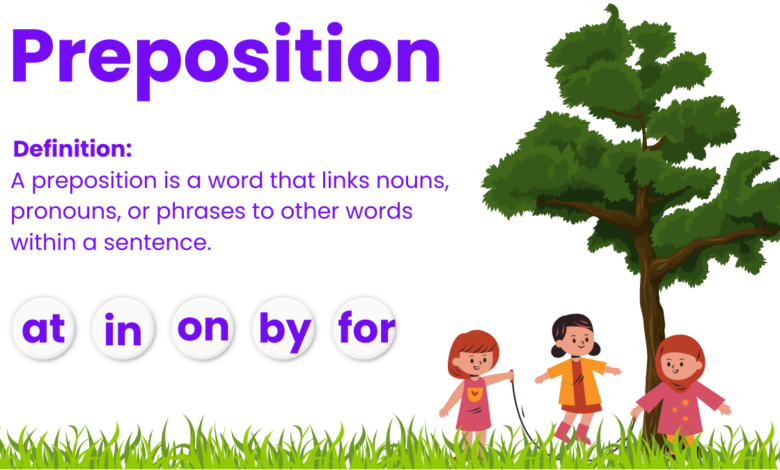
A preposition is a word that shows the relationship between a noun or pronoun and another word in a sentence. It usually indicates direction, location, time, cause, manner, or possession. In most cases, a preposition comes before a noun or pronoun, which is why it is called a “pre-position,” meaning it is placed before something.
For example, consider the sentence: “The book is on the table.” In this case, the word “on” is the preposition because it explains the relationship between the book and the table. What Is a Preposition It tells us where the book is located. Without the preposition, the sentence would lose its clarity and meaning.
Prepositions often form phrases known as prepositional phrases. A prepositional phrase consists of a preposition, its object, and sometimes modifiers. For instance, in the phrase “under the large bridge,” the word “under” is the preposition, “bridge” is the object, and “the large” describes the object. Together, the phrase provides more information about location.
Another important feature of prepositions is that they link ideas smoothly. What Is a Preposition They help create connections between different parts of a sentence so the message flows naturally. Without these small connecting words, sentences would sound incomplete and awkward.
Understanding the definition of a preposition provides the foundation for learning how to use them effectively. Once you know their basic function, you can start recognizing them in everyday language and using them more confidently in your own writing.
The Role of Prepositions in Sentence Structure
Prepositions play a vital role in building clear and meaningful sentences. They act as connectors that show relationships between different elements within a sentence. These relationships can involve location, direction, time, cause, method, or comparison.
One of the most common roles of prepositions is to describe location. Words such as “in,” “on,” “under,” “beside,” and “between” help explain where something is positioned. For example, in the sentence “The keys are in the drawer,” the preposition “in” explains the location of the keys relative to the drawer.
Prepositions also help describe time relationships. What Is a Preposition Words like “before,” “after,” “during,” and “until” indicate when something happens. For example, in the sentence “We will meet after lunch,” the preposition “after” tells us the timing of the meeting.
Another important role of prepositions is to explain direction or movement. Words such as “to,” “into,” “onto,” and “through” indicate how something moves from one place to another. For instance, in the sentence “She walked into the room,” the preposition “into” describes the direction of movement.
In addition to these functions, prepositions can also show relationships involving purpose, cause, or possession. Because of their flexibility, What Is a Preposition they allow speakers and writers to express complex ideas with simple words. Their ability to connect ideas smoothly makes them a fundamental part of English communication.
Common Examples of Prepositions in English
English contains many commonly used prepositions. What Is a Preposition Some appear so frequently in daily communication that native speakers often use them automatically without thinking about their grammatical role.
Some of the most common prepositions include words such as “in,” “on,” “at,” “by,” “for,” “with,” “about,” “from,” “to,” and “of.” These simple words appear in countless sentences across different contexts. Despite their simplicity, they can carry many meanings depending on how they are used.
For example, the preposition “in” often refers to something inside a space. You might say, “The cat is in the box” or “She lives in the city.” In both cases, the preposition indicates enclosure or location within something.
Similarly, the preposition “on” usually refers to something positioned on a surface. For instance, “The laptop is on the desk” or “There is a picture on the wall.” The preposition clearly describes the relationship between the object and its surface.
Another example is the preposition “at,” which often refers to a specific point or location. You might say, “He is at the bus stop” or “The meeting starts at noon.” What Is a Preposition Even though the word is small, it provides important information about place or time.
Learning common examples of prepositions helps build familiarity with their usage. As you encounter them regularly in conversation, reading, and writing, their meanings become easier to recognize.
Types of Prepositions in English Grammar
Prepositions can be categorized into different types based on their structure and usage. Understanding these categories helps learners recognize how prepositions function in different contexts.
One common category is simple What Is a Preposition. These are single-word prepositions such as “in,” “on,” “at,” “by,” and “for.” They are the most basic form and appear frequently in everyday language. Even though they are small, they perform many grammatical functions.
Another type is compound prepositions. These consist of two or more words combined to create a single prepositional meaning. Examples include “according to,” “because of,” “in front of,” and “in spite of.” These expressions function as a single unit even though they contain multiple words.
There are also phrase prepositions, which are groups of words that act together as a What Is a Preposition. Examples include phrases such as “on behalf of,” “with regard to,” and “in addition to.” These phrases help express more complex relationships between ideas.
Finally, some prepositions are categorized based on meaning, such as prepositions of time, place, direction, cause, and manner. For example, “before” and “after” relate to time, while “under” and “between” relate to place. Recognizing these categories makes it easier to understand how prepositions communicate relationships in sentences.
Prepositional Phrases and How They Work
A prepositional phrase is a group of words that begins with a What Is a Preposition and ends with its object. The object is usually a noun or pronoun that receives the relationship described by the preposition.
For example, in the phrase “under the table,” the word “under” is the preposition and “table” is the object. The phrase as a whole describes the location of something relative to the table. Prepositional phrases often function as adjectives or adverbs within a sentence.
When a prepositional phrase acts as an adjective, it describes a noun. For instance, in the sentence “The book on the shelf is mine,” the phrase “on the shelf” describes which book is being referred to.
When it acts as an adverb, the phrase modifies a verb, adjective, or another adverb. For example, in the sentence “She ran across the field,” the phrase “across the field” explains where the action happened.
Prepositional phrases can also add detail and depth to writing. What Is a Preposition Instead of using short, simple sentences, writers can include prepositional phrases to provide more information about location, time, or manner. This makes writing more descriptive and engaging.
Understanding how prepositional phrases function helps writers build richer and more precise sentences while maintaining clarity.
Common Mistakes When Using Prepositions
Even experienced English speakers sometimes struggle with prepositions because their usage can vary depending on context. Certain combinations of verbs, adjectives, What Is a Prepositon and nouns require specific prepositions, and these combinations must be learned through practice.
One common mistake involves using the wrong preposition with a verb. For example, learners sometimes say “discuss about” when the correct form is simply “discuss.” Similarly, some people say “married with,” when the correct expression is “married to.”
Another frequent issue involves confusion between similar prepositions such as “in,” “on,” and “at.” These three words often describe time or place, but each has a specific usage pattern. For example, we say “in the morning,” “on Monday,” and “at night.”
Prepositions can also cause problems in translation. When learners translate directly from their native language into English, the preposition used in their language may not match the correct English one. This can lead to awkward or incorrect sentences.
The best way to avoid these mistakes is to learn prepositions through real examples and regular exposure to English. Reading, listening, and practicing writing all help build familiarity with correct usage.
Tips for Mastering Prepositions in Everyday English
Learning prepositions effectively requires consistent practice and exposure to natural language. Instead of trying to memorize long lists, it is more helpful to learn them within sentences and everyday expressions.
One useful strategy is to read regularly in English. Books, articles, and online content provide countless examples of how prepositions are used in context. By observing these patterns, learners gradually develop an intuitive sense of which prepositions sound correct.
Another helpful method is to practice writing sentences using different prepositions. For example, you might create sentences using “in,” “on,” “under,” “between,” and “through.” This practice reinforces understanding and helps build confidence.
Listening to spoken English also plays an important role. Movies, podcasts, and conversations expose learners to real-life usage of prepositions. Hearing them used naturally helps reinforce their meaning and proper placement in sentences.
Finally, it is important to accept that mistakes are part of the learning process. What Is a Preposition Even advanced learners sometimes choose the wrong preposition. With regular practice and attention, however, correct usage becomes more natural over time.
Conclusion
Prepositions may be small words, but they carry significant importance in English grammar. They connect ideas, clarify relationships, and provide essential information about time, location, direction, and cause. Without them, communication would be far less precise and far more confusing.
Understanding what a preposition is and how it functions allows learners to build stronger sentences and communicate more effectively. By studying their definitions, recognizing their roles, and practicing their usage, anyone can become more comfortable with these essential grammatical tools.
Although prepositions can be challenging at first, they become easier to understand through consistent exposure and practice. Reading, writing, listening, and speaking all contribute to developing confidence with prepositions in everyday communication.
In the end, mastering prepositions is an important step toward fluency in English. Once you learn how these small but powerful words work, you gain the ability to express ideas clearly and accurately in both spoken and written language.